Climate Resilience for Local Communities

Climate Resilience for Local Communities
The Adapt-action Web Tool
The Issue / Idea
How do municipalities adapt to a changing climate? How can they become more climate resilient?
The Project
After extensive research to determine the best way to help municipalities, the Adapt-action tool was created – a web-based decision-support tool for municipalities seeking guidance in taking action regarding climate change adaptation.
Adapt-action guides you through the climate change issues of adapting to water scarcity and adapting to flooding. Each is outlined from the environmental changes you will see, to the implications for your community, through to the strategies you can employ to adapt and become more climate resilient.
As you navigate through each issue narrative, you will be able to view and collect information about: predicted climate change impacts and their effects; implications of these impacts on agriculture, health, recreation, infrastructure and biodiversity in your community; and what your municipality can do to prepare and adapt to these expected changes.
The research and tool development were undertaken as part of ABMI’s Biodiversity Management and Climate Change Adaptation project
Adapt-action Web Site

Adapt-action Overview

Research Reports – Year 1


Research Reports – Year 2


Research Reports – Year 3


(Did we miss something important? Let us know!)
Organization
This project was undertaken by
Status
This was a multi-pronged research project begun in 2012, culminating in the release of Adapt-action in
April 2014
Supporters
ABMI Biodiversity Management and Climate Change Adaptation Project
Bear Hazard Assessments for Alberta Municipalities
Bear Hazard Assessments for Alberta Municipalities
A series of assessments to determine the sources of human-bear conflict in specific Alberta communities.
The Issue / Idea
Can municipalities better plan for reducing conflict with bears by assessing their attractants and hazards?
The Project
As the urban and rural footprint and associated human activity in Alberta continues to increase so does the potential for human-bear interactions and conflicts. Alberta Sustainable Resource Development (ASRD) has developed the Alberta Bear-Smart Program (ABSP) as a province-wide initiative with the goal of reducing human-bear conflicts. The potential benefits of a successfully implemented ABSP include increased human safety, reduced bear mortalities and relocations and enhanced habitat security for bears.
The Bear Smart Program is a community driven process that is usually initiated with the development of a bear hazard assessment for the region of concern. A bear hazard report identifies historical and existing locations and practices that have led to human bear conflicts. These report identify gaps in the existing knowledge base in relation to bear-human conflicts and provides recommendations for reducing existing and potential conflict in the region of interest.
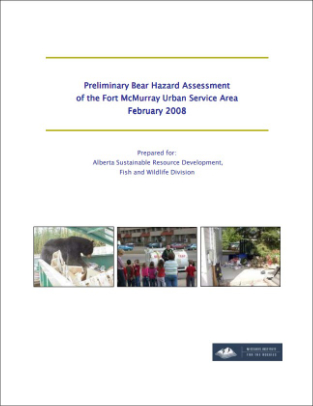
Three separate Bear Hazard Assessments were completed: Municipality of the Crowsnest Pass (2006), Fort McMurray Urban Service Area (2008), and the Smoky Region of Alberta (2011).
Smoky Region

Fort McMurry

Crowsnest Pass

Organization
These assessments were undertaken by
The Miistakis Institute
Status
These assessments were conducted in
2006, 2008, and 2011
Supporters
Alberta Sustainable Resource Development, Fish and Wildlife Division