Urban Ecoroofs

Urban Ecoroofs
Exploring the impacts ecoroofs may have on climate change resilience in Alberta municipalities
The Issue / Idea
What impacts can ecoroofs have on climate change resilience in Alberta municipalities?
The Project
As cities develop, vegetation is typically replaced with non-permeable, non-vegetated surfaces. Ecoroofs are one way to provide some of the lost ecosystem services in urban centres including improved stormwater management (both quantity and quality), better regulation of building temperatures, reduced urban heat island effects, improved air quality, and increased urban wildlife habitat and biodiversity (Oberndorfer et al., 2007). Some jurisdictions refer to ecoroofs as a ‘no-regrets’ climate adaptation measure (Mees, Driessen, Runhaar, & Stamatelos, 2013) because they serve multiple societal goals.
Between 2017 and 2019, the Miistakis Institute partnered with the City of Edmonton, Environmental Strategies team to explore the impacts ecoroofs may have on climate change resilience in the city.
Ecoroof Guide for Municipalities

Ecoroof Fact Sheet

Edmonton Ecoroof Initiative for Climate Change Resiliency: Ecoroof Function Research

Jurisdictional Review
Edmonton Ecoroof Case Studies

Edmonton Ecoroof Website

Organization
This project was undertaken by
The Miistakis Institute
City of Edmonton, Environmental Strategies
Status
This project was
completed in 2019
Supporters
City of Edmonton
Alberta Ecotrust Foundation
Edmonton Community Foundation
Federation of Canadian Municipalities
Rural Residential Expansion Research

Rural Residential Expansion Research
Understanding and mapping rural residential expansion in southwestern Alberta
The Issue / Idea
What is the extent of rural residential expansion in southwestern Alberta?
The Project
In 2003, Miistakis published Spatial Analysis of Rural Residential Expansion in Southwestern Alberta. The report summarizes what we learned from analyzing half a century’s worth of municipal tax assessment data, and describes the patterns and possible drivers of exurban expansion in southwestern Alberta. The data and maps this project produced are some of our most frequently requested resources. In 2006, we revisited the original data in attempt to better understand the spatial distribution of this type of development. Our analysis suggests that rural residences are more likely to occur on sites with scenic views, and with close proximity to golf courses and urban centres. In 2011, Miistakis collaborated with Dr. Michael Quinn at the University of Calgary in an effort to update and expand the Rural Residential Data Set. Work was completed in early 2012, and we now have a complete historical record of more than a century of rural residential expansion for 12 Municipal Districts and Counties in southern and central Alberta.
Spatial Analysis of Rural Residential Expansion in Southwestern Alberta

Rural Residential Expansion in Southern Alberta

Mapping the Exurban Explosion: Rural Residential Expansion in Southwestern Alberta

Rural Residences Map Animation

Organization
This project was undertaken by
The Miistakis Institute
Status
Development of this report and dataset began in 2003 and was
updated and completed in 2012
Supporters
Alberta Ecotrust
Alberta Environment
Henry P. Kendall Foundation
University of Calgary
Alberta Summer Temporary Employment Program
Ecological Values Mapping

Ecological Values Mapping
Providing a visual representation of a municipality’s collective community and conservation values
The Issue / Idea
How does a community accurately map and communicate its most important values?
The Project
In 2007, concerned over mounting development pressure and threats to the landscape and traditional lifestyle of the region, the MD Ranchland approached the Miistakis Institute to help them identify community and conservation values that are important to the MD, and then to map these values as accurately as possible.
Through an open and inclusive process, Miistakis worked with the MD staff, council and residents to identify these values and then express them in a spatial/GIS context. The same methodology could easily be applied to different municipalities, and would be expected to result in the identification of different values.
MD Ranchland – Community & Conservation Values Mapping Project – Phase III Report

One Pager and Previous Phases

Community and Conservation Values Mapping


Organization
This project was undertaken by
The Miistakis Institute
Status
Phase I – data scoping completed in 2007; phase II – mapping tool and user guide completed in 2009; Phase III – enhanced mapping and communication support report completed in 2011
2011
Supporters
Municipal District of Ranchland
Alberta Municipal Affairs’ Municipal Sustainability Program
Climate Resilience for Local Communities

Climate Resilience for Local Communities
The Adapt-action Web Tool
The Issue / Idea
How do municipalities adapt to a changing climate? How can they become more climate resilient?
The Project
After extensive research to determine the best way to help municipalities, the Adapt-action tool was created – a web-based decision-support tool for municipalities seeking guidance in taking action regarding climate change adaptation.
Adapt-action guides you through the climate change issues of adapting to water scarcity and adapting to flooding. Each is outlined from the environmental changes you will see, to the implications for your community, through to the strategies you can employ to adapt and become more climate resilient.
As you navigate through each issue narrative, you will be able to view and collect information about: predicted climate change impacts and their effects; implications of these impacts on agriculture, health, recreation, infrastructure and biodiversity in your community; and what your municipality can do to prepare and adapt to these expected changes.
The research and tool development were undertaken as part of ABMI’s Biodiversity Management and Climate Change Adaptation project
Adapt-action Web Site

Adapt-action Overview

Research Reports – Year 1


Research Reports – Year 2


Research Reports – Year 3


(Did we miss something important? Let us know!)
Organization
This project was undertaken by
Status
This was a multi-pronged research project begun in 2012, culminating in the release of Adapt-action in
April 2014
Supporters
ABMI Biodiversity Management and Climate Change Adaptation Project
Bear Hazard Assessments for Alberta Municipalities
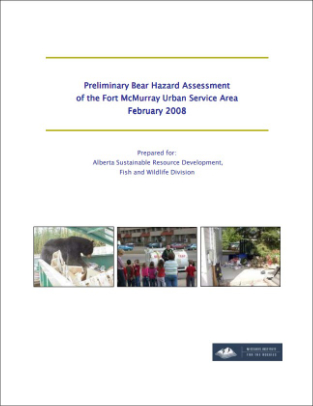
Bear Hazard Assessments for Alberta Municipalities
A series of assessments to determine the sources of human-bear conflict in specific Alberta communities.
The Issue / Idea
Can municipalities better plan for reducing conflict with bears by assessing their attractants and hazards?
The Project
As the urban and rural footprint and associated human activity in Alberta continues to increase so does the potential for human-bear interactions and conflicts. Alberta Sustainable Resource Development (ASRD) has developed the Alberta Bear-Smart Program (ABSP) as a province-wide initiative with the goal of reducing human-bear conflicts. The potential benefits of a successfully implemented ABSP include increased human safety, reduced bear mortalities and relocations and enhanced habitat security for bears.
The Bear Smart Program is a community driven process that is usually initiated with the development of a bear hazard assessment for the region of concern. A bear hazard report identifies historical and existing locations and practices that have led to human bear conflicts. These report identify gaps in the existing knowledge base in relation to bear-human conflicts and provides recommendations for reducing existing and potential conflict in the region of interest.
Three separate Bear Hazard Assessments were completed: Municipality of the Crowsnest Pass (2006), Fort McMurray Urban Service Area (2008), and the Smoky Region of Alberta (2011).
Smoky Region

Fort McMurry

Crowsnest Pass

Organization
These assessments were undertaken by
The Miistakis Institute
Status
These assessments were conducted in
2006, 2008, and 2011
Supporters
Alberta Sustainable Resource Development, Fish and Wildlife Division
Municipal Management of Water Bodies
Municipal Management of Water Bodies
Part 2 of the Municipalities and Environmental Law Series
The Issue / Idea
Municipalities need to better understand what authority they have to regulate the water bodies within their boundaries.
The Project
Alberta’s water bodies are a precious resource, and their regulation and proper management is essential for, among other things, safe drinking water, healthy aquatic ecosystems, and watershed resiliency. This second publication in the Environmental Law Centre’s Municipalities and Environmental Law Series explores when and how municipalities can regulate the water bodies within their boundaries.
Report: Municipal Management of Water Bodies

Organization
This project was undertaken by
The Environmental Law Centre
Status
Development of this publication began with the Municipalities and Environmental Law information series in Fall of 2016, and was completed in
April 2018
Supporters
Max Bell Foundation
Anonymous Foundation
The Scope of Municipal Powers and the Environment

The Scope of Municipal Powers and the Environment
Part 1 of the Municipalities and Environmental Law Series
The Issue / Idea
Municipalities may be unclear as to the role they can play in environmental management.
The Project
Municipal decision-making is increasingly vital to effective environmental management. Today’s municipalities play a central role in developing human settlements and green spaces, managing water bodies, and regulating the ways in which these are impacted. In order to do so, municipalities rely on a variety of legislation that empowers them to make decisions and take action in this regard. The following publication is intended to clarify the sources and the scope of municipal authority with respect to the environment.
Report: The Scope of Municipal Powers and the Environment

Organization
This project was undertaken by
The Environmental Law Centre
Status
Development of this publication began with the Municipalities and Environmental Law information series in Fall of 2016, and was completed in
November 2017
Supporters
Max Bell Foundation
Anonymous Foundation
How Municipalities Apply Environmental Reserve in Alberta
How Municipalities Apply Environmental Reserve in Alberta: A White Paper
A discussion paper to inform municipal planners on how environmental reserve is applied in Alberta and observations on the implications of the new Conservation Reserve tool to ER
The Issue / Idea
How has environmental reserve been interpreted and applied in Alberta? And, did this change with the new conservation reserve tool enabled under the Municipal Government Act?
The Project
To respond to the issue, the Miistakis Institute distributed a survey to understand the municipal application of environmental reserve. The survey was distributed through APPI, AUMA and AAMDC.
Using the outcomes of the survey as a starting point, a discussion paper was developed to provide context for environmental reserve, what the intent is in the MGA, and comments on how it is interpreted and used by municipalities. The paper concludes with a comparison of the previous MGA and the modernized MGA environmental reserve policies, and observations on how the new conservation reserve tool may affect environmental reserve application by municipalities.
Environmental Reserve in Alberta: Discussion Paper

Conservation Reserve Resources


Organization
This project was undertaken by
The Miistakis Institute
Status
This research began in Fall 2016 and was completed in
October 2017
Supporters
Max Bell Foundation
Anonymous Foundation