Ecological Values Mapping

Ecological Values Mapping
Providing a visual representation of a municipality’s collective community and conservation values
The Issue / Idea
How does a community accurately map and communicate its most important values?
The Project
In 2007, concerned over mounting development pressure and threats to the landscape and traditional lifestyle of the region, the MD Ranchland approached the Miistakis Institute to help them identify community and conservation values that are important to the MD, and then to map these values as accurately as possible.
Through an open and inclusive process, Miistakis worked with the MD staff, council and residents to identify these values and then express them in a spatial/GIS context. The same methodology could easily be applied to different municipalities, and would be expected to result in the identification of different values.
MD Ranchland – Community & Conservation Values Mapping Project – Phase III Report

One Pager and Previous Phases

Community and Conservation Values Mapping


Organization
This project was undertaken by
The Miistakis Institute
Status
Phase I – data scoping completed in 2007; phase II – mapping tool and user guide completed in 2009; Phase III – enhanced mapping and communication support report completed in 2011
2011
Supporters
Municipal District of Ranchland
Alberta Municipal Affairs’ Municipal Sustainability Program
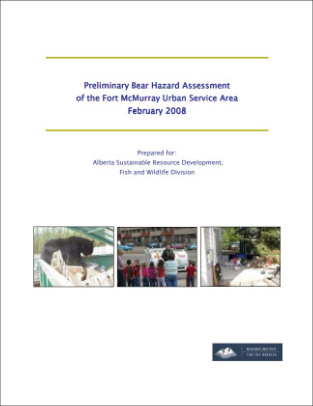
Bear Hazard Assessments for Alberta Municipalities
Bear Hazard Assessments for Alberta Municipalities
A series of assessments to determine the sources of human-bear conflict in specific Alberta communities.
The Issue / Idea
Can municipalities better plan for reducing conflict with bears by assessing their attractants and hazards?
The Project
As the urban and rural footprint and associated human activity in Alberta continues to increase so does the potential for human-bear interactions and conflicts. Alberta Sustainable Resource Development (ASRD) has developed the Alberta Bear-Smart Program (ABSP) as a province-wide initiative with the goal of reducing human-bear conflicts. The potential benefits of a successfully implemented ABSP include increased human safety, reduced bear mortalities and relocations and enhanced habitat security for bears.
The Bear Smart Program is a community driven process that is usually initiated with the development of a bear hazard assessment for the region of concern. A bear hazard report identifies historical and existing locations and practices that have led to human bear conflicts. These report identify gaps in the existing knowledge base in relation to bear-human conflicts and provides recommendations for reducing existing and potential conflict in the region of interest.
Three separate Bear Hazard Assessments were completed: Municipality of the Crowsnest Pass (2006), Fort McMurray Urban Service Area (2008), and the Smoky Region of Alberta (2011).
Smoky Region

Fort McMurry

Crowsnest Pass

Organization
These assessments were undertaken by
The Miistakis Institute
Status
These assessments were conducted in
2006, 2008, and 2011
Supporters
Alberta Sustainable Resource Development, Fish and Wildlife Division
The Scope of Municipal Powers and the Environment

The Scope of Municipal Powers and the Environment
Part 1 of the Municipalities and Environmental Law Series
The Issue / Idea
Municipalities may be unclear as to the role they can play in environmental management.
The Project
Municipal decision-making is increasingly vital to effective environmental management. Today’s municipalities play a central role in developing human settlements and green spaces, managing water bodies, and regulating the ways in which these are impacted. In order to do so, municipalities rely on a variety of legislation that empowers them to make decisions and take action in this regard. The following publication is intended to clarify the sources and the scope of municipal authority with respect to the environment.
Report: The Scope of Municipal Powers and the Environment

Organization
This project was undertaken by
The Environmental Law Centre
Status
Development of this publication began with the Municipalities and Environmental Law information series in Fall of 2016, and was completed in
November 2017
Supporters
Max Bell Foundation
Anonymous Foundation
Municipalities and Environmental Assessment: Primer and Model Bylaw

Municipalities and Environmental Assessment: Primer and Model EA Bylaw
Alberta’s Municipalities and Environmental Assessment: A Primer and Model Bylaw for Alberta’s Municipalities
The Issue / Idea
Through regulation of private land uses and through local land use planning, municipalities play an essential role in the management and protection of Alberta’s environment. While Environmental assessment is a tool that enables better decision-making considering environmental, social, cultural and economic impacts of proposed land uses, municipalities may need support in developing supporting bylaws.
The Project
To enable municipalities to implement effective environmental assessment (EA) processes, the Environmental Law Centre developed a Model EA Bylaw. The Model EA Bylaw is accompanied by a primer which provides relevant background information.
The Model EA Bylaw provides a template for a municipal EA bylaw along with explanatory annotations. The template includes provisions addressing:
- objectives/purposes,
- application of the bylaw,
- process,
- prohibitions, and
- definitions.
The companion primer provides background information on:
- municipal authority over environmental matters,
- municipalities and EA, and
- the elements of a municipal EA bylaw.
Municipal Environmental Assessment: A Model Bylaw for Alberta’s Municipalities

Alberta’s Municipalities and Environmental Assessment: A Primer to the Model Bylaw

Organization
This project was undertaken by
The Environmental Law Centre
Status
Development of the primer and model bylaw began in the Fall of 2016 and was completed in
January 2018
Supporters
Max Bell Foundation
Anonymous Foundation
How Municipalities Apply Environmental Reserve in Alberta
How Municipalities Apply Environmental Reserve in Alberta: A White Paper
A discussion paper to inform municipal planners on how environmental reserve is applied in Alberta and observations on the implications of the new Conservation Reserve tool to ER
The Issue / Idea
How has environmental reserve been interpreted and applied in Alberta? And, did this change with the new conservation reserve tool enabled under the Municipal Government Act?
The Project
To respond to the issue, the Miistakis Institute distributed a survey to understand the municipal application of environmental reserve. The survey was distributed through APPI, AUMA and AAMDC.
Using the outcomes of the survey as a starting point, a discussion paper was developed to provide context for environmental reserve, what the intent is in the MGA, and comments on how it is interpreted and used by municipalities. The paper concludes with a comparison of the previous MGA and the modernized MGA environmental reserve policies, and observations on how the new conservation reserve tool may affect environmental reserve application by municipalities.
Environmental Reserve in Alberta: Discussion Paper

Conservation Reserve Resources


Organization
This project was undertaken by
The Miistakis Institute
Status
This research began in Fall 2016 and was completed in
October 2017
Supporters
Max Bell Foundation
Anonymous Foundation
Conservation Easement Guide for Municipalities

A Conservation Easement Guide for Municipalities
A practical how-to guide for municipalities considering holding conservation easements or establishing a conservation easement program
The Issue / Idea
Municipalities are eligible holders of conservation easements, but have very little information on how – and why – municipalities might go about using this tool.
The Project
To respond to the issue, the Miistakis Institute developed a ‘How To’ guide that informs municipalities about what conservation easements are, the municipal considerations for using this tool, details on what a conservation easement includes, and direction on how to create and administer a conservation easement program. The guide also comes with several Alberta-based resources and templates.
The sections of the guide are:
- The Basics (What is a conservation easement?)
- Conservation Easements and Municipalities (policy, planning, financial, and special considerations
- Administration (preparing, creating, and stewarding a conservation easement and/or program)
Municipal Conservation Easement Guide

Municipal Conservation Easement Fact Sheets


Municipal Conservation Easement Program Resources
(Click on any item to go to it!)
Conservation Easement Web Resources
- CE Alberta Comprehensive Web Resource
- Alberta Conservation Easement Registry
- Canada Land Trust Standards and Practices
- Canada Land Trust Standards and Practices – Backgrounder
Templates and Drafting Resources
- Common conservation easement provisions
- Common conservation easement agreement clauses
- Template Baseline Document Report
- Conservation easement monitoring template
- Strathcona County monitoring template
Example Plans and Policies
-
- Examples – Conservation easements used by Alberta municipalities
-
- Examples – IDP Excerpts
- Alberta Beach Regional IDP (General Development Policies)
- Cypress / Redcliff / Med Hat – Tri Area IDP
- Gull Lake IDP
- Examples – IDP Excerpts
-
- Examples – LUB Excerpts
-
- Examples – Conservation easement Bylaw
- Examples – Other policy excerpts
Provincial Legislation
Support Organizations
(Did we miss something important? Let us know!)
Organization
This project was undertaken by
The Miistakis Institute
Status
This guide was released in
October 2017
Supporters
Max Bell Foundation
Anonymous Foundation
ALSA Tools Webinars

ALSA’s Conservation Tools for Municipalities: A Webinar Series
Informational webinars on conservation easements, transferable development credits, conservation offsets, and conservation directives
The Issue / Idea
The Alberta Land Stewardship Act has conservation and stewardship tools that could be of use to municipalities, but it is unclear how they would work for municipalities.
The Project
To respond to the issue, the Miistakis Institute organized a series of webinars on the four conservation and stewardship tools that are included in the Alberta Land Stewardship Act. Experts in each of the topics were asked to present a one-hour webinar, with each followed by a moderated Q&A session.

The webinars presented were:
Conservation Easements: Tuesday January 24, 2017
Kim Good, Legacy Land Trust Society
Transfer of Development Credits: Tuesday January 31, 2017
Guy Greenaway, Miistakis Institute
Conservation Directives: Tuesday February 7, 2017
Jason Unger, Environmental Law Centre
Conservation Offsets: Tuesday February 14, 2017
Dave Poulton, Poulton Environmental Strategies Inc. & the Alberta Association for Conservation Offsets
The webinars were well-received, with approximately 50 people attending each one. The follow-up evaluations saw the content rated as Excellent (9.5%), Very Good (57%), or Good (33%), with none rating the content as Poor or Fair.
Webinar Files
Conservation Easements (slide deck, video, resource)


Transfer of Development Credits (slide deck, video, resource)


Conservation Directives (slide deck, video, resource)


Conservation Offsets (slide deck, video, resource)


Organization
This project was undertaken by
The Miistakis Institute
Status
The webinars were presented in
January and February 2017
Supporters
Max Bell Foundation
Anonymous Foundation